
Hong Kong Dealers in Precious Metals and Stones (DPMS)
Customer Due Diligence and Beneficial Owner Identification
Under the regulatory framework of the Anti-Money Laundering and Counter-Terrorist Financing Ordinance, Chapter 615 (AMLO), Hong Kong Dealers in Precious Metals and Stones (DPMS), in particular Category B registrants, face stringent compliance scrutiny. Confronted with sophisticated money laundering typologies and cross-border ownership structures, dealers must execute Customer Due Diligence (CDD) and Beneficial Owner (BO) identification.
This guide aims to provide practical operational guidance for Senior Management and Compliance Teams, offering an in-depth analysis of the large-value cash transaction threshold, look-through techniques for multi-layered corporate structures, and enhanced due diligence measures for high-risk customers, assisting DPMS in building a robust compliance system that meets the standards of the Hong Kong Customs and Excise Department (C&ED).
I. Regulatory Requirements and CDD Trigger Mechanisms
Pursuant to the AML/CFT Guideline for Category B Registrants Engaged in Dealing in Precious Metals and Stones issued by the C&ED, Category B registrants must strictly execute statutory customer due diligence procedures when facing high-risk or specified transactions.
1. Trigger Scenarios
Category B registrants must complete CDD before the transaction is concluded when any of the following situations occurs:
-
Specified Cash Transaction:
Conducting a single or linked cumulative physical cash transaction of HKD 120,000 (or equivalent in foreign currency) or above.
-
Suspicion of Money Laundering or Terrorist Financing (AML/CFT):
Regardless of the transaction amount or payment method, whenever doubts arise concerning the customer’s identity or the authenticity of funds.
-
Authenticity Concerns:
When doubts arise as to the authenticity or adequacy of previously obtained customer identification data.
2. Four Core Elements of CDD
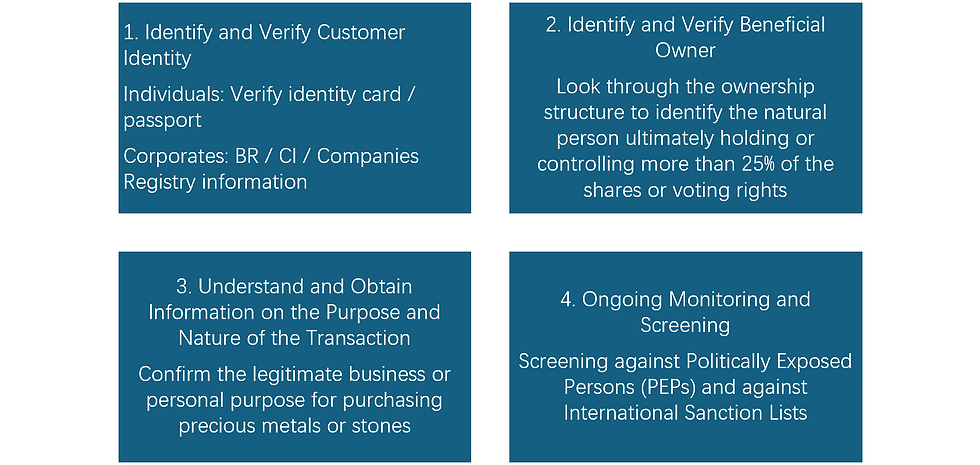
II. Beneficial Owner Identification Practices and Look-Through Techniques
In the precious metals and stones industry, money launderers frequently utilise multi-layered offshore companies, trusts or nominees to conceal true identities and the source of funds. Therefore, looking through complex corporate structures is a core challenge in customer due diligence.
1. Statutory Definition of Beneficial Owner (Using a Corporate Entity as an Example)
Pursuant to AMLO Schedule 2, the beneficial owner of a legal person is a natural person who satisfies any of the following conditions:
-
Directly or indirectly owns or controls more than 25% of the issued shares of the company; or
-
Directly or indirectly controls more than 25% of the shareholders’ voting rights of the company; or
-
Exercises ultimate control over the management of the company through other means.
Important Note: A beneficial owner is always a natural person (i.e., an individual). Regardless of how many layers of offshore companies (e.g., BVI, Cayman) are interposed, compliance personnel must look through the structure until the ultimate major shareholder or actual controller of the company is identified.
2. Ownership Structure Chart and Look-Through Example
When the customer is a legal person, require the customer to provide an ownership structure chart signed by a director and a copy of the Significant Controllers Register.
Example: If Customer Company A is 100% owned by an offshore BVI company, and Mr. Cheung holds 30% of the shares of the BVI company — although Company A is ostensibly a legal entity, Mr. Cheung is the statutory Beneficial Owner (BO) and must be subject to identity verification.
3. Non-Corporate Entities (Trusts and Partnerships)
-
Trusts: Must identify the trustee, settlor, beneficiary and any natural person who exercises ultimate control over the trust.
-
Partnerships: Identify partners who own or control more than 25% of the assets/profit distribution rights, or hold more than 25% of the voting rights.
III. High-Risk Customers and Enhanced Due Diligence (EDD)
When a customer or transaction exhibits high-risk characteristics, Dealers in Precious Metals and Stones must not merely conduct standard customer due diligence, but must execute EDD.
1. Typical Scenarios Triggering Enhanced Due Diligence
-
Politically Exposed Persons (PEPs): The customer, their beneficial owner or agent is a current or former holder of a prominent public function, whether foreign or domestic (including their family members and close associates).
-
High-Risk Jurisdictions/Countries: The customer originates from a country listed on the Financial Action Task Force (FATF) black list or grey list, or from a high-risk sanctioned region.
-
High-Risk Payment Instruments / Complex Transactions: Use of third-party cashier’s orders, offshore account transfers, or where the transaction amount is manifestly disproportionate to the customer’s background.
2. Enhanced Measures Required Under EDD
-
Senior Management Approval: Prior written approval must be obtained from the Money Laundering Reporting Officer (MLRO) or the board of directors before establishing or continuing the business relationship.
-
Verify Source of Funds and Source of Wealth: Require the customer to provide supporting evidence (e.g., audited Financial Audit reports, bank withdrawal slips, asset sale contracts, tax demand notes).
-
Enhanced Ongoing Monitoring: Increase the frequency of review for the customer’s subsequent transactions.
IV. Key Compliance Rules and Record Keeping
合規項目 Compliance Item | 監管要求與實務標準 Rules & Standards |
|---|---|
Document Verification Standards | Individuals: verify original identity card or passport; Corporates: verify Business Registration Certificate (BR) and Companies Registry search reports. |
Record Retention Period | All CDD supporting documents, ownership structure charts, registry search reports and transaction vouchers must be properly retained for at least 5 years from the date of transaction completion or termination of business relationship. |
Refusal to Transact and Suspicious Transaction Report (STR) Submission | If the customer refuses to cooperate with CDD or the beneficial owner cannot be verified, the dealer must not proceed with the transaction and should assess whether to submit a Suspicious Transaction Report (STR) to the Joint Financial Intelligence Unit (JFIU). |
合規項目 Compliance Item | 監管要求與實務標準 Regulatory Needs & Standards |
|---|---|
Document Verification Standards | Individuals: verify original identity card or passport; Corporates: verify Business Registration Certificate (BR) and Companies Registry search reports. |
Record Retention Period | All CDD supporting documents, ownership structure charts, registry search reports and transaction vouchers must be properly retained for at least 5 years from the date of transaction completion or termination of business relationship. |
Refusal to Transact and Suspicious Transaction Report (STR) Submission | If the customer refuses to cooperate with CDD or the beneficial owner cannot be verified, the dealer must not proceed with the transaction and should assess whether to submit a Suspicious Transaction Report (STR) to the Joint Financial Intelligence Unit (JFIU). |
V. Frequently Asked Questions (Q&A)
Q1: Under what circumstances must Dealers in Precious Metals and Stones conduct customer due diligence?
A: Pursuant to Customs regulations, Category B registrants must conduct CDD before the transaction is concluded when any of the following scenarios arises:
Specified Cash Transaction: Conducting a single or linked cumulative physical cash transaction of HKD 120,000 (or equivalent in foreign currency) or above.
Suspicion of Money Laundering / Terrorist Financing: Regardless of the transaction amount or payment method, whenever doubts arise concerning the funds or the customer.
Authenticity Concerns: When doubts arise as to the authenticity or adequacy of previously obtained customer identification data.
Q2: What is the statutory shareholding or voting rights threshold for determining the beneficial owner of a corporate customer?
A: Pursuant to Schedule 2 of Chapter 615, the beneficial owner of a legal person is a natural person who directly or indirectly owns/controls more than 25% of the issued shares, more than 25% of the shareholders’ voting rights, or exercises ultimate control over the management through other means.
Q3: When a PEP purchases large-value precious metals, is it sufficient to conduct only standard customer due diligence?
A: No, Enhanced Due Diligence must be conducted. If the customer, beneficial owner or agent is a current or former holder of a prominent public function, whether foreign or domestic (including family members and close associates), prior written approval from the board of directors must be obtained, and the source of funds and source of wealth must be verified.
Q4: What documents should be verified for individual and corporate customers when conducting CDD?
A:
Individual Customers: Must verify the original identity card or passport.
Corporate Customers: Must verify the Business Registration Certificate (BR) and Companies Registry search documents (e.g., NSC1 / NAR1), an ownership structure chart signed by a director, and the Significant Controllers Register.
Q5: If a customer refuses to cooperate in providing CDD documents or conceals the beneficial owner, what should the dealer do?
A: The dealer must not proceed with the transaction. Furthermore, the compliance department should assess the customer’s intent and risk in concealing their identity, and determine whether to submit a Suspicious Transaction Report to the Joint Financial Intelligence Unit (JFIU).
VI. Professional Services ComplianceOne Provides for DPMS
ComplianceOne Consultants Limited ("ComplianceOne") has successfully assisted numerous jewellers and precious metals investment companies in completing DPMS registration, including both Category A and Category B applications. We provide the following one-stop services:
-
Eligibility Assessment: Identify your company’s business model and recommend the most suitable registration category
-
Application Preparation: Assist in organising business registration documents, completing application forms and submitting them to the Hong Kong Customs
-
AML System Development (Category B): Draft customer due diligence policies, establish ongoing monitoring and suspicious transaction reporting mechanisms
-
Staff Training: Provide AML compliance training for management and staff
-
Independent Audit (Category B): Conduct periodic independent reviews of the AML system
-
Annual Renewal: Assist with Category B Registration renewal applications
-
Automated Screening System: Provide compliant screening and AML/customer management systems
Note: ComplianceOne is a licensed Trust or Company Service Provider (TCSP Licence No.: TC007463), with extensive experience in handling various financial and non-financial compliance matters.
Conclusion
Implementing CDD and BO identification is not only a mandatory response to the statutory regulatory requirements of the C&ED, but also a critical cornerstone for DPMS to safeguard business integrity and long-term operational security. From identifying specified cash transactions of HKD 120,000 to looking through layer by layer of complex offshore structures to identify the ultimate natural person, dealers must strictly adhere to the "risk-based" principle and ensure all CDD records are properly retained for at least 5 years. In the face of an ever-evolving compliance landscape, enterprises should continuously optimise internal controls, transforming compliance requirements into competitive market advantages and achieving sustainable and robust business development.